
What Causes Tile and Grout to Crack? 5 Hidden Reasons
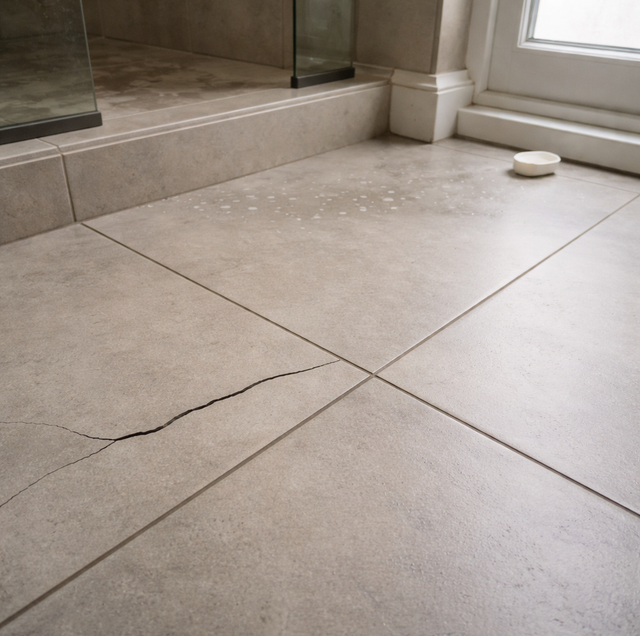
You wipe down the floor, and there it is again: a hairline running through the grout, or a tile that has split clean across for no reason you can name. You fill it, and weeks later it opens back up. The frustrating part is that the crack is rarely the real problem. It is a symptom. Something underneath the finished surface is moving, hollow, or built wrong, and the tile and grout are just the first place that movement shows.
Tile is hard, but it is also brittle. It has almost no give. Grout, the mortar between the tiles, has even less. So a tiled surface only stays intact as long as everything beneath it stays still and fully supported. Understand what is moving or missing under there, and every crack pattern starts to make sense.
Quick Answer: Cracked grout usually comes from movement: a subfloor that flexes underfoot, missing movement joints, or house settling. Cracked tile usually comes from an unsound base under it: voids where the tile was never fully bonded, a hard impact, or a substrate that was never rigid enough. Fixing the surface without fixing the cause just resets the clock.
Why the Base Under the Tile Decides Everything
A tile assembly is only as stable as what it sits on. Picture the layers from the top down: tile, then a bed of thinset mortar bonding it, then the substrate (the structural surface underneath), then the framing that carries the whole floor. When any of those lower layers moves more than the tile can tolerate, the stress travels up and releases as a crack in the weakest spot, which is the grout line or the tile face.
Two ideas explain most of what you will ever see.
Deflection is how much a floor flexes when weight crosses it. Every wood-framed floor bends a little. The industry rule of thumb is that a floor for tile should not deflect more than a small fraction of its span, roughly the length divided by 360 for ceramic and even stiffer for stone. If the joists are undersized, spanning too far, or spaced too wide, the floor bounces just enough underfoot to work the grout loose over time. You often feel this before you see it: a slight give or a faint rattle in a nearby cabinet when someone walks by.
Support is whether the tile is fully bonded across its whole underside. Thinset is not glue you dab in the corners. It has to be combed out and pressed so the ridges collapse into a continuous bed, leaving no air pockets. Where coverage is thin or missing, the tile bridges a hollow. Step on that hollow spot, or drop something on it, and the unsupported tile flexes and snaps.
What Actually Cracks the Grout
Grout is rigid cement. It cannot stretch. So grout cracks whenever the surface it fills is asked to move, and there are a handful of usual suspects.
A flexing or bouncy subfloor: This is the most common cause of grout that keeps reopening. If the floor deflects under foot traffic, the grout lines flex with it. Cement has almost no tolerance for that, so it powders and lets go, often in a long straight run that follows a joist below.
Missing movement joints: Tile expands and contracts slightly with temperature and humidity, and a large tiled area needs somewhere to absorb that. A soft, flexible joint (a bead of the right sealant) belongs at the perimeter, wherever tile meets a wall or cabinet, and at any change of plane such as where a floor meets a step. Skip those, butt the tile hard against a fixed wall, and the field has nowhere to go. The pressure has to release somewhere, and it does, as a crack.
Grout mixed or cured wrong: Grout is chemistry, not just powder and water. Too much water in the mix, or water added again partway through to loosen it, weakens the cured grout and leaves it crumbly and prone to cracking. Cement-based grout in a spot that flexes also wants a latex or polymer additive for a bit of flexibility; leave it out and the grout stays stiff and brittle. Curing it too fast in a hot, dry room can also leave it weak.
House settling: Older homes keep moving in slow ways: a foundation settling a hair, a beam relaxing, seasonal shifts as framing takes on and gives off moisture through humid and dry stretches of the year. That movement is normal, but a rigid tile floor telegraphs it as fine cracks, often near a doorway or a long wall.
One clarification that saves a lot of grief: the joints at inside corners, where two walls meet or where a wall meets the floor, should be caulk, not grout. Those corners are exactly where two planes move independently, so grout there is guaranteed to crack. Flexible caulk, color-matched to the grout, flexes with the movement and stays intact.
What Actually Cracks the Tile
When the tile body itself splits, the cause is usually below it, not in it. A sound tile bonded to a sound base is remarkably tough.
Voids and hollow spots: This traces straight back to thinset coverage. A tile set on partial coverage has unsupported areas underneath.
Tap across the floor with a coin or a knuckle. A solid, fully bonded tile gives a dull, tight sound, while a hollow one rings or sounds drummy. Those drummy tiles are the ones that crack, because nothing behind them resists the load.
Impact: A dropped cast-iron pan, a heavy tool, furniture dragged across the floor, or a sharp point loading one spot can fracture even a well-set tile. Impact cracks tend to radiate from a single point and are usually confined to the one tile that took the hit, which is how you tell them apart from movement cracks that run in a line across several tiles and their grout.
An unsuitable substrate: Tile needs a rigid, dimensionally stable base. Plain plywood or oriented strand board alone does not qualify, because wood swells and shrinks with moisture and flexes more than tile can survive. A proper installation adds a cement backer board, a fortified mortar bed, or an uncoupling membrane. That last one is a thin layer that lets the tile and the subfloor move independently by a tiny amount, absorbing the difference so it never reaches the tile. Tile bonded straight to bare plywood is one of the most common reasons a floor cracks within a year or two.
Can You Just Regrout, or Does the Base Need Fixing?
This is the question that decides whether the repair lasts. Regrouting only makes sense if the tiles themselves are solid and fully bonded and the cracking was cosmetic, for example grout that dried out or was mixed too wet but sits on a stable, non-flexing floor. In that narrow case, raking out the old grout and replacing it (with the right additive) can hold for years.
But if the grout keeps cracking in the same lines, or you can feel the floor move, or nearby tiles sound hollow when tapped, new grout will crack again on the same schedule. The movement or the void is still there. Fixing it properly means getting under the surface: stiffening the floor framing to cut deflection, tearing out and resetting hollow tiles on full thinset coverage, adding a proper backer or uncoupling layer, and cutting in real movement joints. Less satisfying than a quick regrout, but it is the difference between a repair and a reset.
An honest tell: if you have regrouted the same joint more than once and it keeps returning, stop refilling it. The grout is doing its job by telling you the base has a problem the surface cannot fix.
When a Crack Signals Something Bigger
Most tile cracks are an installation issue, not an emergency. A few patterns deserve a closer look, because they point to structure or water rather than workmanship.
Cracks that run in a long, continuous line across multiple tiles and the grout between them, especially in the same direction as the floor joists, can indicate real structural deflection or a framing problem. Cracks that widen over time, appear alongside a floor that feels increasingly spongy, or show up with doors and windows that have started sticking are worth having a professional assess.
Moisture is the other flag. Grout that stays damp, darkens, smells musty, or crumbles wet points to water getting behind the tile, from a failed shower pan, a slow supply leak, or missing waterproofing. Left alone, that rots the substrate and the framing, and the cracking accelerates as the base softens. Cracks paired with any sign of water are a reason to open things up sooner rather than later.
A note on the repair itself: cutting or grinding tile releases fine silica dust that is harmful to breathe, so that work calls for a proper respirator and dust control, not a quick pass with a dry saw in a closed room. And a floor that flexes noticeably or cracks that keep coming back are worth a professional's eyes, since the fix may reach into the framing.
Frequently Asked Questions
Yes. Porcelain is fired denser and harder than standard ceramic and resists impact and wear better, while natural stone like marble or slate can have internal veins and fissures that split along those weak lines. Large-format tiles, anything over about 15 inches on a side, are less forgiving of an uneven substrate, because a small hump or dip loads all the stress into one point under a big rigid piece. The larger the tile, the flatter and better-supported the base has to be.
A tile floor set on a correctly built base, with adequate thinset coverage and movement joints in place, should go decades without cracking; many outlast the rooms they are in. Cracking inside the first year or two is almost always an installation shortcut rather than normal wear, which is why early cracks are worth diagnosing rather than just filling.
Ordinary indoor swings rarely crack tile on their own, but tile over a heated floor or in a sunroom that cycles between warm and cold sees more expansion and contraction, and that is exactly where missing movement joints show up fastest. The mechanism works in both directions across the year: heat expands the field in warmer months, and contraction pulls it in cooler ones, so a floor without room to move gets stressed regardless of season.
Epoxy grout is far more water-resistant and stain-resistant than cement grout and bonds more strongly, so it resists crumbling and is popular in showers and wet areas. It will not save you from a moving substrate, though. If the floor flexes, epoxy grout can still crack or debond, and because it is so hard, it may pop the tile edge instead. It solves durability and staining, not movement.
Usually because that room's floor framing is weaker or spans farther, so it deflects more than the rest of the house. Rooms added later, bonus rooms over garages, and spaces above long unsupported spans are common culprits. It can also be the one room where movement joints were skipped, or the substrate was different, so the same house can have one problem floor while every other tiled surface stays sound.
A single hairline in one tile from a known impact is often cosmetic and stable, and you can monitor it. What you should not ignore is water reaching it, since a crack in a shower or near a tub lets moisture into the substrate, or a crack that grows, multiplies, or is joined by hollow-sounding neighbors, which signals the bond or the base is failing and the problem is spreading.
Book a free tile and substrate assessment before you regrout again — get a fix that lasts, not another patch. Elite Edge Painting & Remodeling serves Parkville, Baltimore, and Towson. Call (443) 601-5233.
