
How to Spot Storm Damage on Your Roof Before It Becomes a Leak
The Morning After a Storm
The wind dies down sometime before dawn, and you step outside with a cup of coffee to survey the damage. A few branches are down. A patio chair is on its side by the fence. The gutters look fine from where you're standing. So you shrug, clean up the yard, and go about your week.
Then, three weeks later, a faint brown ring shows up on the ceiling in the spare bedroom. It wasn't there before. Now you're standing on a chair with a flashlight, wondering how long that stain has been growing behind the drywall and whether the storm from three weeks ago is actually to blame.
This is how roof damage usually plays out. It rarely announces itself the day of the storm. Wind and hail do their work quietly, and the roof often keeps shedding water just well enough that nothing shows up inside the house for days or weeks. By the time you see a stain, water has usually been finding its way in for a while already. Catching the signs early, right after a storm rather than after a leak forms, is what keeps a repair small.
What Wind and Hail Actually Do to a Roof
To know what to look for, it helps to understand what a storm actually does to the materials up there.
Asphalt shingles are layered like fish scales, with each row overlapping the one below it and sealed with an adhesive strip that bonds in the sun's heat. Strong, gusting wind gets underneath the edge of a shingle and works it like a lever. If the wind is strong enough, or the seal has already weakened from age and sun exposure, the shingle lifts, cracks along its seal line, or tears off completely. Even when a shingle doesn't fully detach, a broken seal means it can no longer lie flat, and every subsequent rain has an easier path beneath it.
Hail works differently. A hailstone doesn't usually punch a hole through a shingle. It hits like a small hammer, bruising the surface and knocking loose the protective granules embedded in the asphalt. Think of those granules as the roof's sunscreen: they shield the asphalt mat underneath from ultraviolet light and slow the drying and cracking that comes with sun and heat exposure. Once a patch of granules is gone, that spot of shingle ages faster than the rest of the roof, and it becomes brittle and prone to cracking months down the line, long after the storm itself is forgotten.
Flashing, the thin metal strips sealing the joints around chimneys, skylights, and roof valleys, takes a different kind of beating. Wind can pry an edge loose or bend it, and the caulking or sealant around it is already under stress from ordinary temperature swings. Repeated freezing and thawing cause materials to expand and contract, and that constant movement is what causes caulk and sealant joints to crack even without a storm. A hard storm just speeds up a process that was already underway.
Ground-Level Signs You Can Check Safely
Checking your roof after a storm does not mean climbing onto it. That's a job for someone with the right fall-protection gear, ladder, and experience walking a wet or steeply pitched surface, and it's not worth the risk of a fall to save a phone call. What you can do, and what's actually useful, is a careful look from the ground and from your gutters.
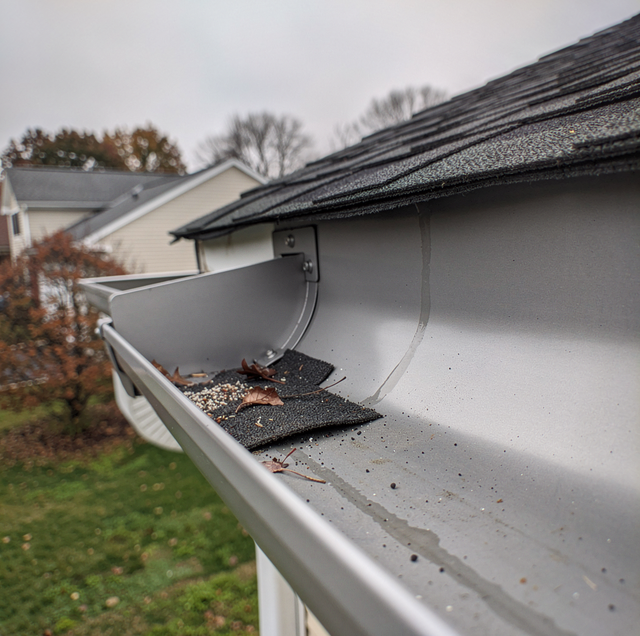
Start by walking the perimeter of your house and looking at your gutters and downspouts. After hail, you're checking for small dark grains collecting in the bottom of the gutter or in the splash zone below a downspout. Those granules are the same ones that get knocked loose from the shingle surface, and finding a noticeable amount after a storm is one of the clearest ground-level signs that hail made contact with real force.
Look at the gutters and at any exposed metal vents, flashing, or downspouts. Hail dents soft metal the same way it dents a car hood, so small round dimples on gutters, vent caps, or flashing are a strong clue about the size and force of the hail that fell, even if you can't see the shingles clearly from below.
Scan the roofline itself from a distance, ideally from across the yard or from an upstairs window. You're looking for shingles that appear to be curling at the edges, lying at an odd angle compared to their neighbors, or missing altogether, leaving a bare patch where the underlying material shows through. Also glance at the ridge line at the top of the roof, since ridge cap shingles take a direct hit from wind and are often the first to lift or go missing.
Signs Inside the House
Some of the most reliable warning signs aren't on the roof at all. They're inside your home, and they're worth checking even if the outside looks fine.
If you have access to your attic, bring a flashlight and look at the underside of the roof deck and the rafters. You're looking for any spot of daylight coming through where it shouldn't, damp or discolored wood, or a musty smell that wasn't there before. Trapped moisture in an attic space doesn't just rot wood; combined with warm, humid air, it also creates an environment where mold and mildew take hold quickly, so a damp attic after a storm deserves a prompt second look rather than a wait-and-see approach.
Inside living spaces, walk each room and look up. A new stain on the ceiling, paint that's started to bubble or peel in one spot, or a soft patch in the drywall are all signs that water has been getting through the roof assembly for some time already, since it usually takes more than one rain event for a stain to become visible from below. Check closets and corners too, since those are easy to overlook and often show the first small signs before a stain reaches the middle of a ceiling.
What a Professional Roof Inspection Adds
Ground-level checks are a good first pass, but they can't tell you everything. A trained eye walking the actual roof surface can see things a homeowner looking up from the yard simply can't: hairline cracks along a shingle's surface, a seal that's lifted just enough to let water in during driving rain but not enough to be visible from below, or flashing that's pulled a fraction of an inch away from a chimney. A professional also checks ventilation, since a roof that isn't venting properly traps heat and moisture that speed up wear on the shingles from underneath, independent of any storm damage on top.
An inspection after a storm typically includes a full walk of the roof surface, a check of every flashing point and valley, a look at the attic from the inside, and photos of anything found so you have a clear record of the roof's condition right after the event, while the damage is still fresh and easy to tie to that specific storm.
Recording Damage for an Insurance Claim
If an inspection turns up storm damage, having it recorded well matters for whatever comes next. This is where a company that offers storm-damage insurance-claim help earns its keep: rather than you trying to describe hail dings and lifted shingles over the phone, a contractor familiar with storm damage can walk the roof, photograph specific problem areas, and put together a written record that lays out what was found and where.
That kind of support is about organizing and presenting what the roof actually shows, not about telling you what your policy covers or how a claim should be decided. Those questions belong with your insurance provider or an agent. What a contractor can do is make sure the physical evidence- granule loss, cracked seals, damaged flashing- is captured clearly and completely before any repair work covers it up.
What to Do If You Suspect Storm Damage
If you've spotted any of the ground-level signs above, or you've noticed a new stain inside, the next step is a phone call rather than a ladder. Note the date of the storm if you can, take photos of anything visible from the ground or from inside, and schedule a professional inspection while the damage is still recent and easy to link to a specific weather event.
Waiting rarely helps. A small lifted shingle or a cracked flashing seal doesn't heal on its own, and each rain that follows tends to work its way a little further into the roof deck and the structure underneath. What starts as a repair limited to a few shingles and a bead of new sealant can turn into a larger job involving roof decking, insulation, drywall, and paint if it sits unaddressed through another season of rain, freeze-thaw cycles, and summer heat. Catching it early is almost always the smaller, simpler job.
Frequently Asked Questions
Longer than most people expect. A cracked shingle seal or a small piece of lifted flashing can let in just a trickle of water at first, and it sometimes takes several rain events, or even a full season of freeze-thaw swings, before that trickle finds a path through the insulation and shows up as a ceiling stain. A roof that looked fine a week after a storm can still reveal problems weeks or months later.
Yes. Metal panels tend to show hail impact as small dents or dimples rather than granule loss, since there's no granule layer to knock loose, and the concern is more about the panel's protective coating cracking at the dent than about the metal failing outright. Tile is more brittle in a different way: a hard hailstone can crack or shatter a single tile without disturbing the ones around it, so a few cracked tiles can easily hide among hundreds of intact ones until someone looks closely.
Yes, and this is one of the more overlooked risks. Wind can loosen a shingle's adhesive seal without pulling the shingle free, leaving it still in place but no longer bonded down. From the ground, that roof looks completely normal. The first sign of trouble is often a leak during the next heavy rain, when wind-driven water is pushed sideways under the unsealed edge rather than running off the surface.
They're generally the first trouble spots, because every joint where something interrupts the flat roof surface- a chimney, a skylight, a vent pipe- relies on flashing and sealant rather than overlapping shingles to stay watertight. Those joints already move slightly with temperature changes, so they tend to develop small gaps before the open shingle field does, and a storm's wind and debris can widen an existing gap that was already forming.
Leave branches, leaves, and other debris where they are rather than climbing up to clear them yourself. Wet leaves and small branches can hide soft spots or already-damaged shingles underneath, and debris removal is often bundled into the same visit as a storm inspection, so a professional can clear it safely while also checking what's underneath for cracks or granule loss.
It's reasonable to ask for a second look. A contractor who regularly inspects storm-affected roofs and offers insurance-claim help can walk the roof again and put together photos and notes of the specific areas in question. That kind of independent record gives you something concrete to bring back into the conversation with your insurer, rather than relying on memory or a single walk-through.
Schedule a post-storm roof inspection — get a clear, photo-documented assessment of wind and hail damage before it leads to an interior leak. Elite Edge Painting & Remodeling serves Parkville, Baltimore, and Towson. Call (443) 601-5233.
