
What’s the Best Time of Year to Paint Outdoors? Four Numbers
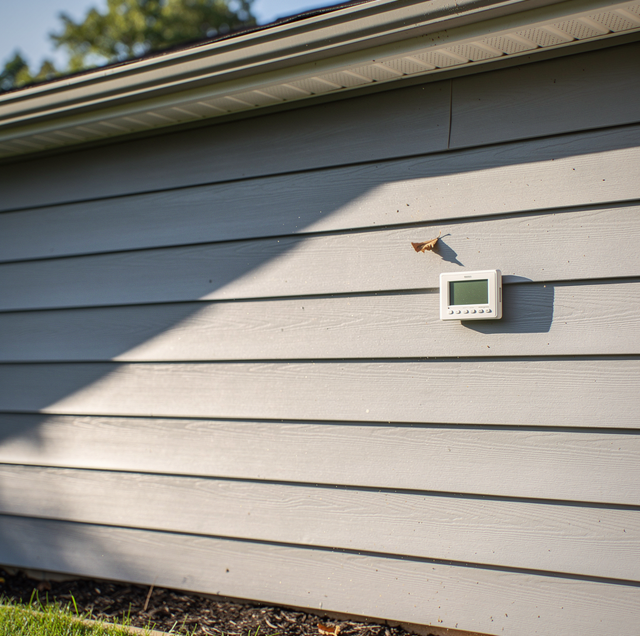
Lay your hand flat on the sunny side of a house at three in the afternoon in early spring, then do the same on the shaded side. The difference comes straight through your palm, and the porch thermometer between those walls has read one number the whole time. The forecast reports that number. The coating responds to the wall.
So the title question resolves into conditions rather than months. A coating either forms a continuous film or it does not, and that is settled by what the siding is doing at the hour you brush it and through the hours after.
Four readings decide it: the surface temperature itself, the floor below which latex cannot fuse, the margin between surface and dew point, and the gap between a film that has dried and one that has cured. Some months make all four easier to hit; every month has days that miss them.
Surface Temperature Is the One the Coating Feels
A paint film forms in contact with the substrate, and heat moves between the two by conduction, the fast path, so the film's temperature tracks the board it lies on. Air conducts poorly and keeps moving past, so it has far less say.
Sunlight is why the wall runs high. A surface in direct sun absorbs shortwave radiation faster than it radiates heat back to the air, so the elevation the sun is at can be past a coating's upper application limit while the shaded side of the same house remains within range.
Night is why it runs low. The wall radiates longwave energy toward a sky that is effectively very cold on a clear night. With no cloud cover returning it and no wind mixing warmer air against the surface, siding can settle a few degrees below the air temperature by dawn.
So one house runs four schedules at once: the east wall may be the only one warm enough at eight in the morning and the one that is too hot by one in the afternoon, while the north side has only then cleared the floor.
Why Latex Stops Forming a Film When the Wall Is Cold
A latex or acrylic coating is a dispersion of solid polymer particles in water, stabilized by a coalescing solvent. On a wall, the water leaves, and capillary forces press the crowded particles together. Then the step that matters happens: they deform against each other, and their chains diffuse across the boundaries until separate spheres become one membrane.
That deformation requires soft particles, and softness is temperature-dependent. Below a certain temperature, they stay rigid. The threshold has a name, minimum film formation temperature, and a standard test: a temperature-gradient method draws a wet film down a bar held across a range of temperatures, and the dried film is clear above the threshold and cracked and powdery below it.
The number on a can sits above that threshold rather than at it. A manufacturer adds a margin over the resin's film-formation temperature and the dry time the coating needs down there, so the label figure is the measured property plus a working cushion.
A minimum application temperature is accompanied by a duration. Your product's application directions print the figure and the number of hours the surface has to hold above it, and an evening coat is where the second number gets missed.
Which is why a cold-morning coat can look perfect and fail the following year. Water still evaporates at 42 degrees, so the film goes touch-dry and looks like paint while a packed layer of unfused particles with open boundaries sits on the wall. Fusion runs long after drying finishes, so a wall that clears the threshold at noon and drops back under it by nine spends the bulk of its coalescence window on the wrong side of the number.
The Dew Point Sets Your Stop Time for the Day
Dew point is the temperature at which air becomes saturated with the vapor it already carries, and any surface at or below it pulls liquid water onto itself. Dew point is characteristic of the air mass and drifts slowly; surface temperature swings quickly, and that asymmetry is the problem.
The working margin is five degrees Fahrenheit, or about three degrees Celsius: apply only while the surface reads that much above the dew point. The margin also has to survive the night while the film is still fusing.
Follow it through an ordinary evening. The last coat goes on the west wall at half past four and the sun leaves that elevation at six. The wall radiates heat to the sky immediately, so its temperature falls while the air remains warm. The dew point barely moves, the gap closes from the surface side, and on a clear, calm night it closes before the light does.
What lands on the film then is liquid water, on a coating whose particles have not finished diffusing into one another. It re-swells the top layer, interrupts fusion partway through, and leaves the surface porous and soft. So the hour to calculate at four in the afternoon is when the surface temperature will come within five degrees of the dew point; sunset falls later and makes a poor marker.
Wind and Sun Push Drying Ahead of Curing
Drying and curing run on two clocks, but only one is visible. Drying is the loss of water and solvent from the film, driven by temperature, air movement, and the moisture already in the air. Curing is coalescence, driven by temperature and time, and a windy, sunny wall accelerates the first without touching the second. An alkyd cures by reacting with oxygen, so cold slows it without imposing a fusion floor.
Wind strips away the saturated boundary layer sitting on the wet film, so water leaves fast, open time collapses, and a wet edge stops taking a brush before the pass is finished. Coalescence gets no help from any of it.
Direct sun on a hot wall splits the clocks the other way: the outermost layer sets over material still fluid beneath it, and what is underneath pushes out against a closed skin, raising small blisters in the newest coat within an hour or two. The application directions carry an upper surface limit for that reason, and reading a failed film afterward to name which cause lifted it is a diagnostic question rather than a scheduling one.
The recoat interval hides the same trap. A recoat time is quoted at specific reference conditions, and a figure quoted at 77 degrees Fahrenheit and 50 percent relative humidity says nothing about a wall at 55 degrees and 80 percent, where the real interval stretches well past it and a second coat laid on schedule goes over a first that has not finished.
Some Months Make These Four Readings Easier to Hit
Now the calendar comes back. In the long-day stretch of the year, the binding reading is the upper limit: sun-struck elevations run past it for hours, open time collapses on a warm windy wall, and a humid night closes the dew point margin as early as a cool dry one. The season pays that back after dark, holding the surface above the coalescence floor so an evening coat is still fusing at three in the morning.
The mild shoulder stretches trade that away for daylight. Surface temperatures sit inside the range on the sunny and shaded sides at once, the widest choice of walls in the year and the one stretch where the upper limit stops mattering. What shortens the day at both ends is dew, which has to leave the siding first, and the slide toward the dew point that starts in mid-afternoon. Overnight lows then decide it: a 62-degree afternoon followed by a 38-degree night clears the first reading and fails the second.
Cold weather inverts the problem. Dry air means low dew points and a margin wide enough to stop being the question, which leaves the floor holding the whole decision. Low-temperature formulations move that floor down with extra coalescing solvent and buy real hours around midday, but a wall that struggles to 40 by noon is under the threshold again by early evening, so those hours cover the label's duration on their own.
Which turns a calendar question into a shorter one: on a given elevation, how many usable hours sit between the surface clearing the floor and the surface closing on the dew point? Answer that for each side of the house, in the order the sun leaves them, and you have a schedule.
Frequently Asked Questions
Take the reading off the surface you plan to coat, late enough that the wall has shaken off the night. Masonry lags air temperature by hours because of its heat capacity, so brick can sit below the floor at two in the afternoon on a 60-degree day while the wood trim beside it cleared the number by ten.
Look for the rain-resistance time in the application directions. It is a separate figure from dry-to-touch and recoat, and it names the interval a coating needs before water landing on it stops doing damage. It is stated at reference conditions, so cool air and a damp surface stretch it, and a film short of that point washes and streaks.
An under-fused film is porous. The particle boundaries never closed, so water passes through a coating that still looks intact, wets the wood behind it, and works on the bond from the back. The coating gets through the mild months looking fine and lets go after a full wet-dry cycle, a season or two after the day that caused it.
It changes the surface temperature, which changes the window. Solar absorptance is the complement of the reflectance a color publishes: a near-black film reflects under a tenth of the light landing on it and takes in the rest, while a white one sends back roughly three-quarters. The light reflectance value on the chip gives you that figure, and a dark elevation crosses the upper limit hours earlier.
Morning, on any wall that has finished shedding its dew, since a film applied at nine has the warm part of the day ahead of it. Which wall is the complication: a surface peaks two to three hours after solar noon rather than at it, because it absorbs faster than it sheds well into the afternoon, so a west elevation at four sits near its hottest reading.
Check your infrared thermometer's distance-to-spot ratio first: at 12:1, it averages a one-foot circle from twelve feet back, so a reading from the driveway includes trim and shadow lines too. Step in until the spot fits within the course you are coating. It also assumes an emissivity near 0.95, which holds on painted wood and masonry and fails on bare bright metal.
A free exterior estimate that starts at the walls themselves — surface readings, elevation order, and the hours each side of the house actually gives you before a date goes on the calendar. Elite Edge Painting & Remodeling serves Parkville, Baltimore, and Towson. Call (443) 601-5233.
