
What Causes Exterior Paint to Blister? Read the Dome
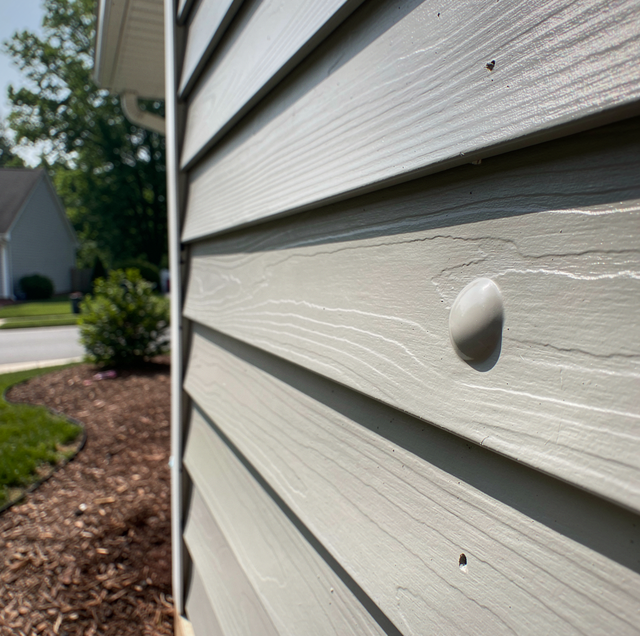
You run a thumb along the sunny side of the house, and the paint gives under it, a soft dome the size of a coin, whole across the top and still stuck down around the rim. The skin has not broken, and the film remains bonded at its edges, which is why it can hold air, vapor, or liquid water inside rather than tearing open and letting the contents dry out. Every blister on that wall is a sealed sample of the moment the bond let go, and the second one splits, the evidence dries out and blows into the flower bed.
Peeling is the same failure one step later. Once the dome splits, the edges curl, wind and rain work behind the film, and the loose piece comes off as a flake or a strip. By then the evidence has gone with it: the wood has dried, the underside of the film has been rained on, and the pattern that would have named the cause is somewhere in the flower bed. An intact blister is a sealed sample of the moment the bond let go, so read it before the scraper comes out.
A Blister Is Intact Film Lifted Off Its Substrate
Two things decide whether a coating stays put: the strength of the bond at the interface, and the force pulling straight out against that bond. Paint fails by blistering when the pulling force wins in the middle of an area while the bond survives at the edges. The lift spreads outward from the weakest point until it meets film that is still holding, and that boundary becomes the rim you can feel with a fingernail.
A film only domes if it is flexible enough to stretch. A 100 percent acrylic exterior coating stays elastic for years, so it balloons rather than splits. A hardened alkyd film has lost most of that stretch, so the same pressure cracks it into flakes instead. The blistering itself is partly a report on how much life the coating has left.
Press one before cutting it. A dome that feels soft and springy still holds fluid or vapor and is under active pressure. One that is dry, crisp, and crackles under a thumb has finished failing some time ago and left an air pocket behind.
What Is Under the Dome Names the Mechanism
Cut a blister at its edge, not through the middle, with a fresh utility blade held at a shallow angle. That leaves a flap you can fold back with the substrate intact beneath it. Two surfaces matter: the underside of the film, and the face of whatever it lifted off.
On a building painted before 1978, treat every coat as lead-bearing. Opening one blister with a wetted blade is a small contained cut. Removal is not: no dry scraping, no dry sanding, no open flame, no heat tool above 1,100 degrees Fahrenheit.
Six findings cover almost every blister on a wall. The one that needs explaining is liquid water: a bead that wets your finger is condensation, not rain that got in. Vapor moving through the wall reached its dew point against the cold back of the film and turned to water there.
| What you find under the dome | How far it goes | What it points at |
|---|---|---|
| Liquid water or a damp, dark stain | To bare substrate | Vapor or liquid water pushed out from behind the film |
| Dry, clean, sharp-grained bare wood | To bare substrate | A moisture event that has since dried out |
| Small, tight, dry pockets in the newest coat | Stops at an intact earlier coat | Painted too hot or in direct sun |
| Loose powder that marks a cloth | Stops at an intact earlier coat | Painted over a chalked surface |
| Glossy old paint with no scratch pattern | Stops at an intact earlier coat | Painted over gloss that was never dulled |
| Dirt, pollen, or a soapy residue | Either | Painted over a wall that was not washed |
How Deep the Blister Goes Tells You Which Coat Failed
Count the layers at the cut edge. If the blister goes to bare wood, fiber cement, or masonry, the whole stack is released at once, and the failure occurs at the substrate interface. That points at what was happening at the substrate: water arriving from behind, or a surface that was damp, dirty, or chalky on the day it was coated.
If the blister stops on an intact earlier coat, the failure is between coats. The newest layer never bonded to the one below it, or it trapped its own solvent while curing. Interlayer blisters are shallower, tighter, and confined to the last coat applied, and the paint underneath them still looks sound.
Age changes the reading. A blister that goes to bare wood three months after a repaint accuses the application. The same blister on a nine-year-old coating accuses the wall: something started delivering water to the back of that film after the job was finished.
Where the Blisters Sit Points at the Water Source
Position on the elevation carries as much information as the dome's contents. Blisters in the bottom one or two courses of siding follow splashback off a hard surface, sprinkler spray aimed at the house, or a deck that throws water back at the wall.
Clusters around window sills, at butt joints, and where a board end meets trim follow end grain. Cut ends absorb water many times faster than a board's face, and an unpainted or uncaulked end is an open straw into the middle of a wall.
Blisters on the walls that back bathrooms, kitchens, and laundry rooms follow indoor water, and so do blisters near a bath fan or dryer termination that dumps into a soffit instead of through a hood to the outdoors. Blisters under a deep eave are the most telling of all, because rain never reaches that band of siding. When paint lifts where the wall stays dry from the outside, the water came from inside.
Two patterns accuse the paint job rather than the wall: broad, even fields across one whole elevation point at conditions on the day that side was coated, and small blisters following brush strokes or lap lines point at film thickness and how fast that stretch was drying.
Vapor Driven Out From Behind the Film Is the Most Common Cause
Water vapor moves from warm, humid air toward cold, dry air, which, through a cold-weather wall, means inside to outside. It works through drywall, insulation, sheathing, and siding until it reaches the paint film, often the least permeable layer in the assembly. If the film cannot pass vapor as fast as it arrives, the vapor condenses against the back of it, and the pressure lifts the coating off the wood.
Permeability is why two houses on the same street behave differently. Alkyd and oil-based films pass far less vapor than 100 percent acrylic films, so an oil topcoat over a wall carrying an indoor moisture load blisters sooner than an acrylic one would. Each additional coat further lowers permeance, so a wall with seven repaints is tighter than one with two.
Liquid water produces the same dome by a shorter route. A failed caulk joint above a window, an open miter in trim, or flashing that has lost its lap delivers water directly behind the film, where it has no exit except through the coating. The indoor sources worth chasing are ordinary: a bath fan wired to a switch nobody uses, a dryer vented into an attic, a crawlspace with an open dirt floor.
Hot Walls and Early Dew Raise Blisters at Application
A curing film has to release what carries it. In a latex, that is water plus a coalescing solvent; in an alkyd, mineral spirits. On a hot substrate or in direct sunlight, the top of the film skins over while the layer beneath remains fluid. The solvent below flashes to vapor with nowhere to go but up against a surface that has already closed, and it lifts that skin into small blisters, often within an hour or two of the brush passing.
The signature is consistent: small, tight domes, dry and clean inside, in the newest coat only, heaviest where the sun was strongest or the film went on thick. Most exterior acrylics specify a minimum of 50 degrees Fahrenheit for air and surface, with low-temperature formulations rated to about 35 degrees, and an upper limit commonly near 90 degrees at the surface.
Check the wall, not the forecast. An infrared thermometer on a dark, sun-struck elevation often reads 30 to 50 degrees Fahrenheit above the air temperature, so follow the shade around the house and coat each side after the sun has left it.
Timing does the same damage from the other direction. A latex film can be dry to the touch in an hour and still be days from full coalescence, the stage where the resin particles fuse into one continuous membrane. Dew, fog, or a shower landing before that happens pushes water into the young film, raising fine blisters evenly across everything coated late in the day rather than only at hot spots.
Chalk, Gloss, and Wet Wood Leave a Bond That Never Formed
Some blisters have no pressure story at all. The film never held on, and the first stress that came along lifted it off the wall in a dome.
Chalk is the most common version. Ultraviolet light breaks down the binder at the outermost few microns of an aged film, freeing the pigment it held. What is left is loose powder on sound paint, and a new coat bonds to the powder, which is bonded to nothing. Rub the wall with a dark cloth: a heavy transfer means it needs washing until the cloth stays clean.
Gloss is the second version. A hard, slick, unabraded film gives a new coat nothing to key into, and the bond that forms is thin enough that vapor pressure or one hot day breaks it.
Wet wood is the third. Coating siding whose moisture content is above roughly 15 percent seals water into the board, and the board then dries the only way left to it, straight out through the new film. Dirt and pollen sit between the coating and the substrate the same way. Mildew on a film surface is a growth problem rather than an adhesion problem and does not lift paint by itself; a live colony painted over becomes one more contaminant the new coat cannot bond through.
Preparation is the common thread under all three: wash off what is loose, dull what is slick, and let the wood dry before anything is applied. Primer choice matters at the repaint, but the outcome depends on the surface the film is asked to grip.
Frequently Asked Questions
Many of them do. As the moisture behind a dome dries, the pressure drops and the film settles back against the wall, which is why blisters that appear after a wet stretch can look gone a week later. The bond is still broken underneath. The re-flattened area shows a faint outline where the film stretched and did not fully recover, and the same spots blister again on the next wet cycle.
Coating over a blister traps the same pressure, adding to the problem. A typical exterior acrylic goes on around 4 mils wet and dries to roughly 1.5 mils, so every extra coat makes the film thicker and less able to pass vapor, which is the opposite of what a moisture blister needs. The failed film has to come off back to a sound edge first.
Not always, but they can. Indoor vapor produces blisters that come and go with the weather, while a real leak keeps a patch of wall wet through a dry stretch and usually tracks a plumbing line, a window head, or a flashing detail. A pin-type moisture meter through the failed area settles it. Framing at or above 20 percent moisture is wet enough to support decay fungi, making it a structural question rather than a paint one.
Longer than most people expect. Give wood siding 24 to 48 hours of dry weather after a soaking rain before you coat it, and longer for end grain or anything that was saturated. Dew point matters as much as elapsed time: apply only when the surface sits at least 5 degrees Fahrenheit above the dew point, so a cool morning wall can be too damp even after two dry days.
Yes, because neither material absorbs or releases water the way wood does. Vapor travels behind them and escapes at the seams, so blisters there trace to contamination or trapped water at a joint rather than to the substrate. Vinyl adds a heat limit of its own: a dark color can push a panel past its heat-distortion point and warp it, which is why vinyl-safe coatings are formulated to a light reflectance value of about 55 or higher.
No, and confusing the two leads to unnecessary scraping. Surfactant leaching appears as glossy tan or brown streaks and droplets on top of a new film, usually within the first few weeks after painting and after a cool, damp night. Those are water-soluble ingredients from the coating rising to the surface, not a bond failure, and the film beneath is fully attached. Most of it washes off with water and a soft brush.
Book a free exterior evaluation before the next repaint — a walkthrough that reads the blistering pattern and identifies the water source rather than coating over it. Elite Edge Painting & Remodeling serves Parkville, Baltimore, and Towson. Call (443) 601-5233.
