
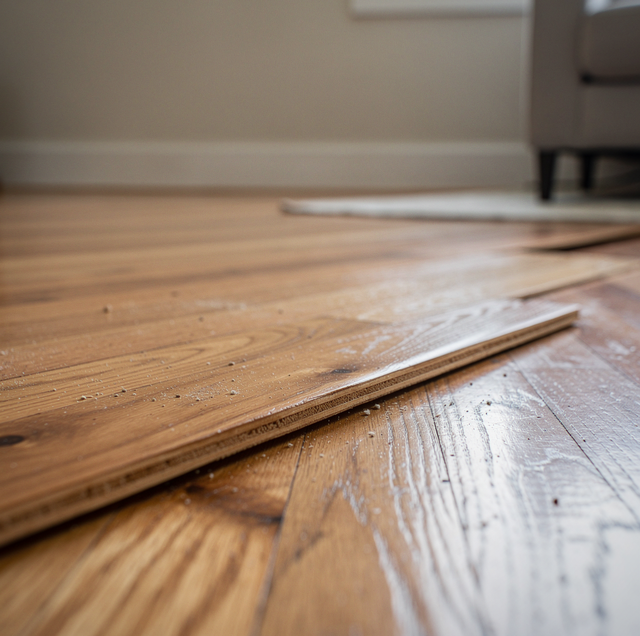
A hardwood floor doesn't wear out flat and even; it bends first. The boards underfoot move with the moisture around them, and when one face of a board takes on more water than the other, the wood bends toward the drier side. That bend is information: edges standing higher than the center point to moisture entering from below, and a center that domes above the edges points to the opposite, the bottom drying out faster than the top ever got the chance to. The direction of that curve is the first piece of evidence worth reading.
The mechanism is the same one that warps a wooden spoon or a cutting board left standing in a sink of dishwater: wood fibers swell far more across the grain than along it, so a board that takes on moisture unevenly across its thickness has nowhere to go but up or down at the edges. Solid and engineered flooring are built from wood differently, and the same moisture load can shape each one differently as a result.
| Shape | Wetter Face | Likely Source |
|---|---|---|
| Edges raised above center (cupping) | Bottom | Subfloor, slab, or crawlspace moisture; sometimes a leak |
| Center raised above edges (crowning) | Top, or a cupped floor leveled too soon | Surface spills or over-correction during refinishing |
| Boards lifted off the subfloor (true buckling) | Bottom, from a saturating event | Standing water, a failed drain, or a plumbing leak |
| Boards bowed or ridged at a seam | Both faces, from swelling | Expansion gap closed by seasonal humidity |
| Gaps widening between boards | Both, moisture leaving | A dry season below installed moisture level |
Reading the shape points toward a cause; it doesn't confirm one. Each pattern below has its own mechanism, and more than one can be at work in the same room.
Cupping from Below: When the Subfloor Holds More Moisture than the Room
Cupping is the shape most homeowners notice first: a shallow trough down the center of each board. It starts underneath the finish, not on top of it.
Why the cut matters: Solid hardwood is milled one of two ways. Quartersawn boards are cut so the growth rings run close to perpendicular to the face; plainsawn boards are cut so the rings run closer to parallel with it. Wood shrinks and swells more in the tangential direction, following the growth rings, than in the radial direction across them, so a plainsawn board cups more readily than a quartersawn board from the same species under the same exposure. That's a property of the cut, not the installation.
Where the moisture is coming from: Over a plywood or OSB subfloor, a missing or failed vapor retarder lets moisture migrate up into the wood before it reaches the room's air. A concrete slab can still release moisture into the flooring above it, particularly where a vapor retarder wasn't installed correctly beneath it. A crawlspace with exposed soil and no ground cover acts as an open moisture source just below the subfloor; it's worth having a flooring or foundation professional evaluate it rather than assessing it yourself, since a crawlspace isn't a space to enter to chase down a floor problem. A slow plumbing leak under the floor causes a similar localized pattern and is best traced by a plumber, with the flooring treated as the symptom rather than the source.
Crowning: Why a Floor Sanded Flat Too Soon Comes Back Wrong
Crowning is the reverse of cupping: boards dome upward in the center rather than dip, sometimes on a floor that looked flat only a season earlier.
The most common cause isn't a new moisture event; it's history catching up. When a cupped floor gets sanded level while the underside still holds more moisture than the top, the sanding removes material from what were, at that moment, the highest points: the edges. Once that excess moisture finally leaves and the board's moisture content evens out, it tries to return to flat, but there's now less wood at the edges than before, so the center ends up standing proud instead. The earlier fix was simply applied before the floor was dry enough to level correctly. Crowning can also start fresh from a top-side source: furniture or a rug trapping surface moisture against the finish can dry the surrounding boards unevenly, producing the same domed shape with no sanding history at all.
Buckling: Boards Lifted off the Subfloor or Simply Grown into the Gap
Buckling is the most severe form of shape change, often confused with a milder problem that looks similar at first glance.
True buckling: A board, or several in a section, actually separates from the subfloor and rises as a unit, sometimes pulling neighboring boards with it into a visible ridge. This takes more moisture than ordinary cupping, usually a saturating event rather than routine humidity, because the fasteners or adhesive holding the board down have to be overwhelmed by the swelling force.
Boards grown into their expansion gap: Can look alarming without being true buckling. Every installation leaves a gap at the perimeter, tucked under the baseboard or shoe molding, for the floor to expand into. In a humid stretch, boards swollen enough to close that gap and press against each other, with no room left to give, can bow slightly or telegraph pressure along a seam. It looks dramatic, but the floor hasn't detached from the subfloor, and it often relaxes once the gap reopens as humidity drops.
Standing water on a wood floor near an outlet or appliance is a real hazard, not just a flooring problem. Cut power to the area and keep it dry underfoot until the source is found and stopped.
Seasonal Movement That's Normal, and Movement That Isn't
Wood takes on moisture in a humid season and releases it once the heating season dries the air out, and both processes produce a change in shape. In humid months, boards absorb moisture, edges swell slightly, and gaps between boards tighten. Once indoor humidity drops, the wood releases that moisture; boards shrink slightly, and small gaps reopen. That back-and-forth is built into how wood flooring is designed to perform, and a floor that repeats this cycle every year without worsening is behaving normally.
What isn't normal is movement that doesn't reverse: cupping still there, or worse, a season after the humidity that seemed to cause it has passed; a crown with no matching cupping event to explain it; or a shape change confined to one corner while the rest of the room stays flat. That kind of uneven, non-reversing movement points to a specific source, and it's worth having evaluated rather than waited out.
Wet-Cleaning Habits and Surface Water at Entries and Appliances
Not every moisture source comes from below. Steam mops and heavily wet string mops push water into the finish and, over time, into the seams between boards. A damp entry mat holds moisture against a small area far longer than an open floor experiences, and a slow drip from a refrigerator or dishwasher line can wet the same boards day after day without ever pooling enough to be obvious.
These sources produce a localized, top-down pattern rather than the broad, bottom-up cupping associated with subfloor or crawlspace moisture, which is why matching shape and location to a plausible source matters more than guessing from either one alone.
Acclimation and Installation Moisture: The Cause Already Baked In
Some cupping and crowning was set in motion during installation, not by anything that's happened since move-in. Wood flooring is meant to reach something close to equilibrium moisture content, the level at which it neither gains nor loses much more water in its installed environment, before it's nailed or glued down. Boards installed before they've acclimated, straight off a truck or stored somewhere with different humidity than the finished room, carry a different moisture content than the room will eventually settle into.
As the wood equalizes toward the room's actual conditions over the following months, boards that started too wet shrink and can develop gapping, or, if the imbalance runs through the board unevenly, a cupped or crowned shape with no external moisture event behind it at all. This is one reason a shape problem can show up with no leak, no crawlspace issue, and no cleaning habit to blame: the mismatch was already inside the wood before the first board went down.
Confirm the Moisture, Then Let It Dry before Any Repair
The shape of a board is a strong clue, not a diagnosis; confirming what's happening takes a reading, not a guess.
A pin-type moisture meter measures moisture content at a specific depth by driving small probes into the wood, useful for checking below the surface at a board's edge. A pinless meter uses electromagnetic sensing across a wider pad and leaves no mark, making it useful for quickly scanning a larger area to map where moisture is higher. A useful reading compares the board's moisture content to a reading taken at the subfloor, and both to the range specified by the flooring manufacturer for that product, numbers that come from the manufacturer's specification and the meter itself, not from the shape alone.
That reading also sets the order of operations. Whatever is feeding moisture into the floor has to be found and stopped, and the wood needs the chance to dry back toward its normal range before any leveling or replacement is attempted.
Don't sand, level, or replace boards while the subfloor underneath is still wet. That repeats the exact mistake that causes crowning, and the fix will fail again once the wood finishes drying and moves back out of shape.
Once readings confirm the wood and subfloor have returned to a stable range, an assessment, whether that's a cup that's relaxed on its own, a crown that needs leveling, or boards damaged enough to replace, can hold.
Frequently Asked Questions
Many boards relax back toward flat as they give up moisture, provided the cup didn't sit long enough for the compressed fibers to take what's called a compression set, a point past which they no longer spring back even after the moisture that caused the swelling is gone.
A smooth, shallow curve is typical cupping. Edges rising into sharp, pointed ridges, a pattern sometimes called diamonding, signal exposure severe or prolonged enough to push the wood past ordinary swelling, with a higher chance the boards won't return to flat once dry.
A radiant system heats and dries the floor from below rather than the room heating it from above, pulling moisture out of the underside faster than the top face loses it, sometimes producing a crown or edge movement that doesn't match the pattern typical of forced-air heating and cooling.
No. A hygrometer measures the relative humidity of the room's air, while a wood moisture meter measures the moisture content of the board and subfloor. The two don't always move together, since wood responds to air humidity with a lag, so a comfortable room reading doesn't rule out a wet board underneath.
A board pinned in place by a fixed structure like a hearth or a built-in can't move the way a free-floating board can. When it tries to swell, that restraint can force a split along the grain instead of a gentle curve, which is why damage next to a permanent fixture sometimes looks different from damage out in the open field.
Not usually. The adhesive bond under a glued-down engineered floor resists the floor lifting as a unit, so a saturated one is more likely to develop bond failure in isolated spots, patches that sound hollow or feel slightly soft underfoot, rather than the visible ridge typical of a nailed floor.
Request an on-site flooring assessment — get a clear read on what's driving the shape change before any repair is planned. Elite Edge Painting & Remodeling serves Parkville, Baltimore, and Towson. Call (443) 601-5233.
