
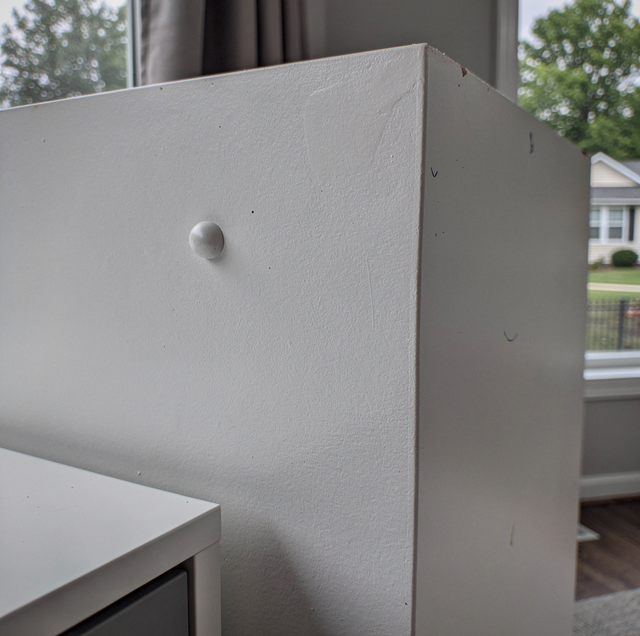
A wall can carry small flaws for years without anyone noticing, and then a fresh coat of paint seems to bring every one of them out at once. That timing has a physical explanation, and it begins with how light interacts with a new film. A new coat of paint is thin, smooth, and uniform in a way an older, dust-dulled surface is not, so it reflects light evenly across the whole wall instead of hiding small irregularities in a mix of grime and faded sheen. A round bump over a fastener, a hairline crack along a seam, or a diagonal crack at a door corner had been forming before the painter arrived. What changed is that the surface can no longer disguise it.
Each mark pairs with the movement behind it and the repair that holds:
| What You See | What's Causing It | The Repair |
|---|---|---|
| A round bump directly over a fastener | A drywall nail or screw has backed partway out of the framing | Pull or reset the nail and add a screw beside it, then patch and refinish |
| A hairline crack running in a straight line | A taped seam between two drywall sheets has separated | Cut out the failed tape, re-embed new tape, and feather several thin coats of compound |
| A diagonal crack from a door or window corner | Stress has concentrated at the cut corner of the drywall | Bridge the crack with reinforcing tape set on the diagonal, then compound and feather |
| A crack along where the ceiling meets the wall | The framing at that joint flexes as it takes on and gives up moisture | Use a flexible joint treatment at that line instead of a rigid one that will just crack again |
Framing Movement and Fastener Backout
Sawn framing lumber can still carry moisture when it goes into the frame. As that wood finishes drying, it shrinks across its width and thickness, with negligible change along its length, and every fastener driven through drywall into it has to ride out that movement. A smooth-shank nail relies only on friction to stay put; as the wood around it contracts and relaxes with moisture swings, that grip weakens a little with each cycle, and the nail head can walk forward until it is proud of the drywall's paper face. A screw resists that process far better, because its threads are cut into the wood fiber itself rather than just pressed against it, giving it a mechanical bite that friction alone cannot match.
How the fastener went in also plays a part. A nail driven at an angle can tear the face paper or sit with one edge of its head proud, and a fastener that only grazes the edge of a stud has little wood to hold it. That is a workmanship variable rather than a wood movement one, which is why two nails a few inches apart on the same stud can behave differently as the framing settles.
Once a fastener has backed out even a fraction of an inch, it pushes the drywall skin outward at that single point, creating a small dome that appears as a bump when paint reflects light evenly across it. The fastener head stays hidden under its compound; what you're looking at is the paper and compound tenting over it once it is no longer flush.
Tape and Seam Cracks
Every flat wall is made of separate drywall sheets, and the joints between them are the weakest point in the whole surface unless they are treated correctly. A seam gets a strip of paper or mesh tape set into a layer of joint compound, then built up with several more coats, feathered wide enough that the eye cannot find the edge. If the first layer of compound doesn't fully bond the tape to the board, or if the tape isn't pressed flat enough to squeeze out trapped air, a thin gap remains at the joint.
That gap doesn't need much to open up into a visible crack. The same moisture and temperature swings that move framing lumber also cause drywall panels to expand and contract slightly, and a seam with a weak bond beneath the tape has nowhere to release that small amount of movement except by splitting along the joint line. A crack of this kind runs in a straight path because it follows the seam, not the random path a crack in solid material would take.
Stress Cracks at Openings
Door and window openings interrupt what would otherwise be a single continuous sheet of drywall, and the resulting cut corners are a weak point in the panel itself. Instead of one board flexing evenly, the load from the wall around the opening funnels down to that one cut corner, and a gypsum panel does not stretch or flex to absorb it. The result is a crack that starts right at the corner and runs on a diagonal, because that is the direction the stress travels as it radiates outward from the point of concentration.
This is also why the same crack can reappear at that exact spot even after a quick patch: filling the visible line with compound closes the gap on the surface, but it does nothing to relieve the concentrated stress still funneling into that corner every time the surrounding framing shifts. A repair that only fills the crack without bridging it with a flexible reinforcing material treats the mark on the surface rather than the point where the movement is occurring.
Why Paint Makes It Show
None of these three mechanisms start when a paintbrush comes out. A popped fastener, a failed seam, or a stress crack at a corner can sit on a wall for a long stretch before anyone paints over it, because an older wall surface is already broken up visually by scuffs, faded color, and a dulled finish that scatters light in every direction. That visual noise hides small changes in the surface underneath it.
A fresh coat of paint removes that camouflage at once. The new film is smooth, uniformly colored, and reflects light consistently across the entire surface, so any place where the wall isn't perfectly flat now stands out rather than blending in. The bump, the crack, and the separation were all there first, and the paint is simply the first surface in a long while without enough surface noise to hide them. That is also why a repair done without addressing the fastener or the seam underneath just delays the same mark from reappearing through the next coat.
Getting the Repair Right Before You Repaint
A lasting fix always goes after the movement, with the surface finish second. For a popped fastener, that means dealing with the fastener itself, not just filling the dome over it: the nail is pulled or reset and a new screw is driven into solid framing an inch or two away, so the board is held flat again before any compound goes on. For a failed seam, the damaged tape has to be removed rather than skimmed over, since compound applied over loose tape will crack again in the same place. New tape goes in, embedded properly, and built up in several thin, feathered coats rather than one thick pass that shrinks unevenly as it cures.
A stress crack at an opening needs a repair that can move slightly with the wall rather than fight it. Bridging the crack with a reinforcing tape set on the diagonal, rather than just packing the gap with compound, gives that corner somewhere to distribute the stress, rather than concentrating it at a single hard point. Each of these repairs finishes the same way: sanded flush, spot-primed so the patch doesn't drink in the topcoat any differently than the surrounding wall, and blended into the surrounding finish so the repair doesn't flash through with a different sheen once the new coat dries.
A nail pop, or a hairline seam or corner crack that holds its width, is cosmetic and comes from ordinary material movement, not a structural problem with the house. A crack that keeps widening by the week, or a nearby door or window that begins sticking in its frame around the same time, points to movement that a paint-and-compound repair alone won't resolve and calls for a look before it is simply patched over again.
A row of pops running up the same stud or along one ceiling joist traces to that one framing member drying or twisting, so the whole line gets refastened with screws rather than patched one bump at a time.
Frequently Asked Questions
Caulk can hide the visible line around a bump for a while because it flexes with small movement, but it does nothing to stop the fastener itself from continuing to work loose underneath it. The lasting fix replaces a smooth nail with a screw or a ring-shank nail, both of which grip the framing with far more resistance to backing out than a plain shank ever will.
Framing at that corner can lift and drop slightly through the year, and a ceiling board fastened tight to that framing right at the corner drags the corner joint with it. The durable fix leaves the ceiling edge unfastened near the wall and holds it with clips at the wall plate, so the ceiling can move without tearing the corner.
A drywall screw long enough to bite about five-eighths of an inch into the stud. For half-inch board, that is a 1-1/4-inch coarse-thread screw, set just below the paper without tearing it. A second screw an inch or two from the old nail pulls the board tight before the pop is filled.
If the original repair only filled the visible dome with compound and never addressed the fastener underneath, the same loose nail or screw is still free to keep moving. A patch applied over an unaddressed fastener is sitting on the same weak point as before, so the bump telegraphs back through the new compound and paint once that fastener shifts again. Hammering the same nail back in drives it into a hole the shrinking wood has already enlarged, so it has even less grip than before and can pop again.
Yes. New framing is still giving up moisture after the drywall goes on, so pops can appear as it shrinks. A pop reset while the framing is still drying can be followed by new ones nearby, which is why repairs done once that shrinkage has run its course are the ones that hold.
It does not worsen the movement, but it adds work later: paint bridging an open crack forms a skin that splits along the same line, and that edge has to be scraped and feathered before tape can bed flat over the crack.
Bring in interior painting with drywall repair worked into the prep — popped nails are refastened with screws, failed seams retaped and stress cracks bridged, so the new color goes over a sound wall. Elite Edge Painting & Remodeling serves Parkville, Baltimore, and Towson. Call (443) 601-5233.