
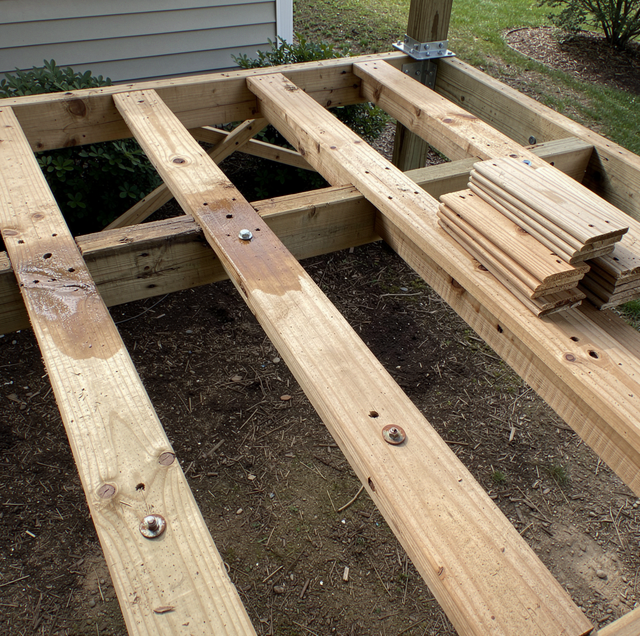
Deck work comes in three sizes. Board-level repair involves swapping out a split plank, resetting a loose railing section, or replacing a handful of corroded fasteners. Resurfacing takes every board off and lays new decking on the joists, beams and posts that are already there. A rebuild replaces the frame itself. The boards are the part you see and walk on, so they start the conversation, yet the choice among those three sizes is determined by the structure beneath them. New decking screwed down to tired joists inherits every weakness of those joists, and a fresh surface over a frame close to worn out means the new boards come off again when that frame gives out.
Each structural layer of a deck reads differently at three stages: still sound, partly worn and past repair.
| Structural layer | Still sound | Partly worn (repairable) | Past repair |
|---|---|---|---|
| Joists | Firm along their length, level across the tops, bearing ends solid | Rot on one face or along a short stretch, sound wood around it | Rot through the member, a span that sags between supports |
| Beams and joist-to-beam connections | Straight, plies tight together, ties and hangers intact | A loose or corroded connection, surface decay on one ply | A beam that has split, twisted, or rotted through, several failed connections |
| Posts and footings | Plumb, sound at the base, footings level and intact | A post base that needs resetting, one footing that has shifted | A post rotted at grade, footings that have settled unevenly |
| Ledger and house attachment | Tight to the wall, flashed, fasteners secure | A few corroded fasteners on an otherwise solid board | Ledger pulling away, or rotted behind the flashing |
| Stairs and stringers | Stringers firm, treads level, landing solid | One cracked tread, a loose stringer connection | Stringers rotted at the ground or split along their length |
| Railing posts | Rigid under hand pressure, sound where they meet the frame | A post that needs added blocking or new hardware | A post rotted where it bolts to the frame, or several posts failing at once |
What Resurfacing Keeps, and Why the Frame Gets Inspected Once the Boards Are Off
Resurfacing rests on one condition: the existing framing has to be worth keeping. The old decking comes up; the joists, beams, posts, and ledger stay, and new boards go down on top.
The step that makes resurfacing safe is the one in the middle. With the boards gone, the tops of every joist, the connections at the beam and the ledger fasteners are exposed at once, a view of the whole frame from above that a finished deck never offers. That is also the stage where a resurfacing plan can turn into a rebuild, if what shows up is more than a few isolated weak spots.
A frame that looks clean from underneath can still carry decay along the joist tops, in the strip where each old board sat and held water against the wood. That strip stays hidden until the decking has been lifted off.
The warning signs that start this conversation open the decision without settling it. What settles it is how deep those problems run once the frame is visible.
Joists and Beams: When Sistering Is Enough and When the Member Goes
A joist carries the decking between supports, and its strength depends on sound wood running its full depth and length. Decay that stays on one face or along a short section leaves the bulk of the cross-section intact. In that case, a new joist fastened alongside the damaged one, called sistering, shares the load and restores the stiffness the rot took away.
Sistering has limits. When rot runs through the full depth of a joist, there is no sound wood left for the sister to fasten into along that stretch. When decay reaches a bearing end, where the joist sits on the beam or hangs from the ledger, the point that transfers load to the rest of the frame has been lost. In both cases, the joist is replaced rather than reinforced.
Beams follow the same logic at a larger scale. A built-up beam is made of several boards fastened face to face, and water can sit in the seams between them. Surface decay on an outer ply can be cut back and reinforced. A beam that has split, twisted, or rotted through carries a whole row of joists with it, so it comes out. The metal ties and hangers that join joists to beams are part of the same assessment: one loose or corroded connection warrants repair, while a row of them indicates the load path across the deck is compromised in more than one place.
A single sagging joist can be sistered. A sag that runs across several joists at the same point can mean the beam or a post under it has dropped, which moves the problem down a layer.
Posts, Footings and a Frame That Has Moved
Posts carry the beams down to footings, and footings carry everything into the ground. A post is exposed hardest at grade, where it meets soil or concrete and where water can pool against the end grain. Rot there takes away support from the bottom, and the beam above drops with it.
Footings fail by moving. A footing that settles or tips lowers one part of the frame, and every joist tied to that beam follows. Because the frame is connected, a single settled footing can put a slope into the walking surface, strain the ledger connection at the house, and open gaps at the railing posts. Repairing a moved footing involves excavating around it, addressing whatever drainage allowed the soil to shift, and bringing the frame back to level, so the original elevations return along with a fix for the cause of the movement.
The line between repair and rebuild at this layer comes down to count and pattern. One post rotted at its base or one footing out of level is a contained repair. Several posts rotted at grade, or footings that have settled by different amounts, mean the frame is now resting on a foundation that no longer matches the geometry it was built to.
A ledger pulling from the house, a post rotted at the base, or a sagging span can let a deck drop under a crowd, a hot tub, or loaded planters, so those loads stay off until a deck crew repairs the frame.
Cutting out a post or joist from under a loaded frame is work for a crew with temporary supports in place, and no load-bearing member should be removed or replaced by the homeowner.
The Ledger and the House Connection
The ledger is the board bolted to the house that carries one full edge of the deck. The joists hang from it, so the entire side of the deck nearest the house depends on that one attachment.
Water is what threatens it. Rain running down the wall or off the decking can get behind the ledger when the flashing above it has failed or was never installed. Once water sits there, it rots the ledger from the back and can rot the house rim joist it is fastened to. The front face can look sound while the wood behind it has lost its grip on the fasteners. A ledger held with nails alone carries its own weakness, because nails can work loose under the steady outward pull of the deck.
A ledger with a few corroded fasteners in otherwise solid wood can be refastened and reflashed. A ledger that has rotted, or pulled away from a rotted rim, is the connection a rebuild replaces, along with any damaged section of the house framing behind it.
Connectors and Fasteners Across the Frame
Every layer in the table is joined to the next by metal: joist hangers, post bases, beam ties, ledger bolts, and the screws and nails between them. That hardware can corrode while the surrounding wood remains sound. Rust streaks bleeding down from a fastener, flaking or thinning hanger flanges, and screw heads standing proud of the boards all show a connection losing its hold.
What matters for the decision is whether corrosion is local or systemic. A few rusted hangers in a wet corner get replaced one by one. Corrosion spread through connections across the whole frame means the joints that hold the structure together are weakening everywhere at once, and replacing them one at a time leaves the rest of the frame on the same failing hardware.
Counting the Layers That Are Failing
Damage confined to one layer on an otherwise sound deck is a repair followed, if you choose, by resurfacing. Once two joists with surface rot are sistered, the frame takes new boards.
The picture changes when the failures spread across layers. Rotted joists alongside settled footings, a compromised ledger and corrosion through the connectors mean the repair list touches nearly every part of the frame. A string of partial repairs then leaves a patchwork: new members bolted to old ones, reset posts under a tired beam, fresh hardware beside failing hardware. Each repair is sound on its own, but the frame as a whole is only as dependable as its weakest remaining original part. Replacing the frame gives one consistent structure with every member and connection at the same starting point.
Stringers rotted at the ground, and a railing that moves under hand pressure count here too, and both are kept clear of people until repaired.
Probing, Leveling and Checking Each Connection
Probing joists, beams and posts along their length and at their ends finds decay that the surface hides. A level or a string line run across the joist tops and along the beam shows whether the frame has sagged or settled, and by how much at each point. Each connection gets checked in turn: ledger fasteners and flashing, hangers, ties and post bases.
With those findings in hand, the decision rests on the frame's condition, not the appearance of the boards. A deck with a sound frame and a worn surface is a resurfacing job, even if the old boards look beyond saving. A deck with a surface that still looks presentable over a frame failing in several layers is a rebuild. Whether a structural repair or a rebuild needs a permit is decided by the local building department, and where one is required, the contractor handles the paperwork as part of the project.
Frequently Asked Questions
It can, but both change what the frame has to do. Some composite products and any diagonal board layout may call for joists set closer together than the original layout, so the existing frame may need additional joists or blocking before the new surface goes down.
Yes. A self-adhering joist tape laid over the tops of the joists and beams before the new boards go down sheds water away from the wood and seals around each new fastener hole. It slows decay along the joist tops, though it cannot restore wood that has already rotted.
Only when each footing is intact, has not moved, and sits where the new post layout needs it. A larger footprint, a changed post layout, or a heavier planned load can require new or larger footings, and a footing that is cracked or undermined is replaced.
It can when it reaches the frame. Earthen mud tubes running up footings or posts mark subterranean termites, which hollow wood along the grain out of sight. Round, clean-edged holes about half an inch across on the undersides of exposed boards are carpenter bee galleries; they become a structural question where the tunnels have been extended through a load-bearing member.
Treated lumber comes in above-ground and ground-contact grades. A post or stair stringer cut from above-ground stock and set in soil or against wet concrete can decay early, and so can cut ends that expose the less-treated core of the wood if they are left unsealed.
The copper-based preservatives in current treated lumber corrode plain or thinly coated steel. Connectors and fasteners in treated wood require a heavy hot-dip galvanized coating or stainless steel; mixing the two metals in a single connection can cause galvanic corrosion.
Reserve deck repair with resurfacing or a full frame rebuild — joists, beams, posts, footings, the ledger and new decking. Elite Edge Painting & Remodeling serves Parkville, Baltimore, and Towson. Call (443) 601-5233.