
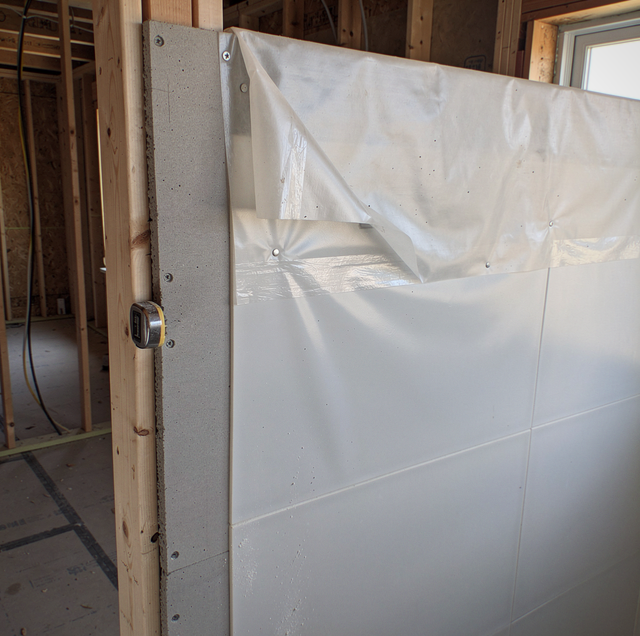
You have probably heard that tile is a good choice for a shower because it withstands water. That is true, and it is also where a lot of confusion starts. A tiled wall can look completely sealed and still let water pass straight through it, because the tile itself was never the part doing the sealing. The real barrier, if the shower has one, is a separate layer installed before a single tile goes up. Whether that layer is there and whether it was done right determines whether a shower lasts for decades or starts rotting the wall behind it long before the tile shows it.
Tile Sheds Water, But It Isn't the Seal
Ceramic and porcelain tile are dense and largely impervious on their own faces. Water beads and runs off a glazed face. That is real, and it is only part of the picture, because a shower wall is not a single solid sheet of tile. It is dozens or hundreds of individual pieces set close together, and every seam between them is a joint, not a barrier.
Porcelain is defined by a very low water absorption rate, which is why it withstands water better than standard ceramic tile, but even a low-absorption tile does nothing for the gaps around it. Water does not need to soak through the tile body to reach the wall behind it. It only needs a path along one grout line, one corner, or one spot where the caulk has pulled away, and a shower delivers thousands of gallons a year straight at those paths.
Grout Lets Water Through; It Doesn't Stop It
Sealing grout slows how much water it soaks up, but it does not make the joint watertight. Over a shower's life, grout also develops hairline cracks in the field where tiles meet, and each crack is a direct route for water to reach whatever is behind the wall.
Cement grout is porous by nature, and even epoxy grout, which absorbs far less, is still a joint rather than a barrier. Where a shower wall meets another wall or the floor, the joint is meant to be flexible sealant, not grout, and any sealant bead that has pulled away is an open door.
The Membrane Is the Only Continuous Barrier Behind the Tile
A waterproof membrane is a different kind of layer entirely. Instead of a porous material that slows water down, it is a continuous, unbroken plane, either a sheet product bonded across the whole wall and floor, or a liquid coating rolled or troweled on that cures into a rubber-like film. Its entire job is to stop water at that plane and route it back out, rather than letting it keep moving toward the framing.
Ask the installer to flood-test the shower floor's pan or membrane for about 24 hours before tile goes on. A water line that drops at that stage means a patch to the membrane, not a tear-out through finished tile.
What makes a membrane work is continuity. A membrane with a gap, a puncture, or a seam that was not lapped and sealed correctly is not really a membrane at that spot; it is a hole in one. Corners, the transition from wall to floor, and every place a pipe or drain body passes through the wall are the places a membrane installation succeeds or fails, because those are the joints where a sheet has to be cut, folded, or sealed around an obstruction rather than run flat. A membrane installed carelessly at a single inside corner can leave the whole shower exposed at that one seam, even though every other square foot performs exactly as intended.
What the Backer Board Can Handle, and What It Can't
Behind the membrane (or, in an unprotected shower, directly behind the thinset) sits the board, usually a cement backer board built for wet areas. In a membrane system the tile's thinset bonds to the membrane, not to the board; thinset is a cement-based setting bed that holds the tile but is porous like grout and stops no water on its own. That board is a real improvement over ordinary drywall, which softens, swells, and loses structural integrity when it stays wet.
But water-resistant is not the same claim as waterproof. Cement board is still a porous material with small voids, and it will absorb and pass moisture that reaches its surface. It is built to survive dampness without falling apart, not to stop water from continuing to whatever is behind it. Treating a water-resistant board as the shower's water barrier is a mistake, because the board looks and feels solid enough to be mistaken for the seal.
What Happens to the Framing When That Layer Is Skipped
Skip the membrane, or install it with a gap, and water that gets past the tile and grout keeps traveling. It reaches the backer board, passes through it as any porous material eventually lets water through with repeated exposure, and reaches the wood framing and insulation behind the wall. Framing enclosed behind a finished wall gets almost no airflow, so wood that takes on water stays wet between showers. Sustained moisture there leads to wood rot that weakens the studs over years, and it also creates the exact conditions mold needs behind a wall where nobody can see it forming.
The tile can look completely fine while this happens. That is the frustrating part for homeowners: there is often no visible sign at the surface until grout starts cracking in new places because the substrate underneath has begun to soften, or a musty smell develops, or a tile near the floor starts to feel loose. By the time any of that is visible, the damage has been building out of sight.
If you suspect hidden water damage behind a shower wall (musty odor, soft tile, discoloration), do not cut into the wall yourself. A remodeling crew can safely assess the extent of rot and mold exposure and determine what needs to be removed.
Sheet, Liquid, and Foam: How Different Showers Get Waterproofed
There is more than one accepted way to build this layer, and the right one depends on the shower's design.
| Membrane Type | How It Works | Typically Used For |
|---|---|---|
| Sheet membrane | A flexible sheet bonded to the board with thinset, with seams overlapped and sealed | Full showers, walls and floor together |
| Liquid-applied membrane | A roll-on or trowel-on coating that cures into a continuous waterproof film | Walls, curbs, and irregular shapes that are hard to cut sheet material around |
| Foam-core panel systems | Pre-fabricated waterproof boards that replace backer board and membrane in one panel, taped and sealed at the seams | New shower builds where the framing is already open |
| Traditional pan liner | A waterproof liner set beneath a mortar bed for the shower floor, with weep holes that let any water that reaches the drain flange escape rather than pool | The shower floor specifically, often paired with a wall membrane above it |
Walls and floors do not always use the same method. It is common for a shower floor to rely on a liner beneath a mortar bed while the walls above use a sheet or liquid membrane over backer board, as long as the two systems tie together at the transition rather than leaving a gap where they meet.
Frequently Asked Questions
Not as the tile backer on its own. Moisture-resistant (green) board resists humidity, but it is not rated as a tile backer in the spray zone. The exception is a bonded sheet-membrane system whose manufacturer lists gypsum board as an approved substrate: there the membrane is the barrier, and the board only holds it flat. Without that membrane, the wall needs cement board or a comparable wet-area substrate.
No. A molded one-piece or multi-piece acrylic or fiberglass shower unit is manufactured as a sealed, waterproof shell, so there is no tile, grout, or backer board involved, and nothing separate needs to be added behind it. The waterproofing question only comes up for tiled showers, where the wall is built up in layers rather than arriving as a single finished piece.
A correctly installed sheet or liquid membrane is designed to outlast the tile job itself and does not wear out on a schedule the way a fixture might. The real risk to a membrane is physical damage, a screw driven through it during a later renovation, or a tile that comes loose and lets water reach a spot the membrane can no longer protect. Because the membrane sits behind the finished wall, it usually cannot be inspected or repaired without removing tile to reach it, which is why getting it right the first time matters so much.
No. A penetrating grout sealer slows how fast the grout absorbs water at the surface, and it needs to be reapplied on the interval printed on that sealer's label, which varies by product, but it does nothing at a cracked grout line, a gap in the caulk, or a seam that has opened up. A sealer manages surface absorption; it does not create a continuous barrier the way a membrane does, so it cannot serve as a substitute.
Yes. A traditional liner does not sit on the flat subfloor. It sits on a mortar pre-slope, commonly about a quarter inch of fall per foot toward the drain, so water that gets through the top mortar bed runs along that slope to the weep holes instead of pooling on it. That pre-slope is what separates a liner floor from a bonded membrane, which is sloped by the setting bed above it.
Yes. A steam generator fills the entire enclosure with warm, moist air rather than directing water at specific surfaces, as a showerhead does. Hence, a steam enclosure typically requires a continuous vapor barrier across the walls and ceiling, not just the areas that would get splashed in a standard shower. Steam finds its way into small gaps that plain splashing water never would, which is why a steam shower is usually treated as its own waterproofing project rather than a slightly wetter version of a regular one.
Have the waterproofing layer planned before any tile is chosen — a remodeling crew picks the membrane system for your walls and floor, with a free estimate. Elite Edge Painting & Remodeling serves Parkville, Baltimore, and Towson. Call (443) 601-5233.